Showing posts with label Straight Play. Show all posts

Thursday, June 14, 2012

Tribes - Moving, Delicate, and Dynamic Theater


                I finished out my whirlwind trip to NYC with my fifth show in two days down in the Village at the Barrow Street Theatre.  Before the show, I took the subway down to Christopher Street, wandered around, got a snack at Amy’s Bread, and had a very pleasant time exploring the neighborhood.  Even though I love to go to New York as often as possible, and so desperately want to be a “local,” let’s face it – I’m a tourist.  I’m a girl who travels up from North Carolina to be amazed by everything New York has to offer.  This was my first time spending quality time wandering around the Village.  I had been to the Lortel Theatre to see Carrie, but I didn’t get to do a whole lot of exploring.  I love the neighborhood.  It’s eclectic and fun.
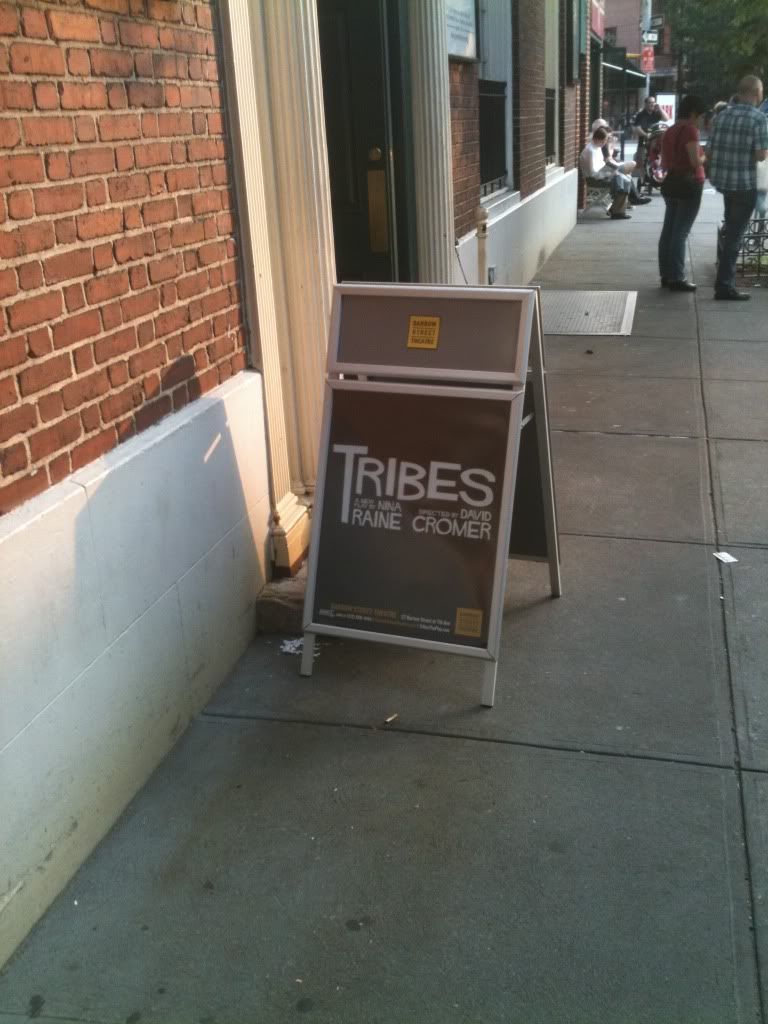
                The Barrow Street Theatre is quite unassuming – it’s in a building called Greenwich House.  Walking by, you’d never know it’s a theater.  I literally had to find the “27” on the building before I was certain that I was in the right place.
                The performance space itself is not big (it is, after all, an Off-Broadway house), but they do so much with it.  There were seats on all four sides of the square performance space in the middle.  The space was a living room/dining area with a gorgeously made “skylight.”
                Tribes tell the story of Billy, a young Deaf man, raised in a hearing family – a family which made no effort to understand that there is such a thing as Deaf culture, and did not teach him sign or anything like that.  He speaks well, and is a skilled lip-reader.  He meets a woman named Sylvia, who comes from a Deaf family, who introduces him to the Deaf world, but who herself is struggling with the fact that she is losing her hearing.
                First of all, I need to get one thing off my chest – I think I’m in love with Russell Harvard, who plays Billy.  Not only is the man an incredibly talented actor who took on a very tough role with Billy, but he’s also extremely easy on the eyes.  Harvard, a deaf actor who has made a name for himself with some key film roles, took on some extremely challenging stuff with Tribes.  He speaks for most of the show, but he also has to make mistakes and such when he speaks, which is challenging.  I saw a funny interview he did in which he reminded the audience to be kind, because he doesn’t actually know what a British accent sounds like.  I think he did a great job, and the folks I was sitting with and I agreed that the accent thing was totally irrelevant.  He did an impeccable job, as did the rest of the stellar ensemble cast.
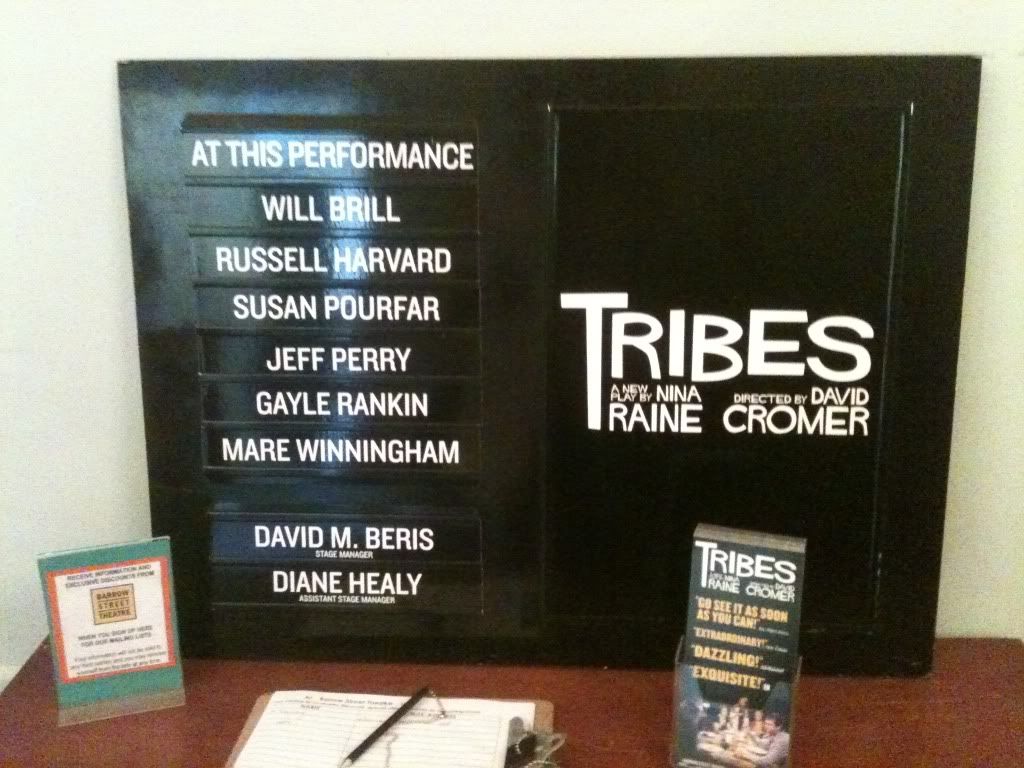
                I was so compelled by this well-told (Drama Desk-winning) story.  It really presented the Deaf world as populated by real people with their own gifts and shortcomings.  Especially having seen Clybourne Park the day before, which showed such a one-dimensional portrayal of a deaf person, I was moved by how real these characters were.  Billy is desperate to find a place he belongs in the world, but also needs to lash out about who he is and the people he comes from.  Sylvia, his love interest and guide into the Deaf world, is such a dynamic and complex character, as she comes from a world which won’t let her mourn the fact that she’s losing her hearing.  The two meet in such a wonderful way that tells such a fantastic story.  Nina Raines (the playwright) never once presents Deafness as a handicap, but she does acknowledge its challenges.  People who are culturally Deaf do not generally view their Deafness as a handicap, but rather as a source of cultural pride.  I only know this from a nominal amount of research that I’ve done, but it’s clear that Raines knows her stuff.  She’s able to tackle big issues in such a delicate yet head-on way.
                I especially enjoyed the scenes of interaction between Billy and his brother.  His brother is battling his own demons, and Billy has been like his anchor for some time.  Truth time: I cried a lot when they interacted.  I was just so moved.
                Along with the beautiful skylight, there were some other creative elements of the show which I really loved.  There was need for some subtitles when characters were only signing and not speaking.  The projections were done on unique surfaces – the side of the window, the mattress, etc., so that it seemed an organic part of that world.  It didn’t seem like “translations,” but just felt like their words popping up.
                I met some really cool people in the audience, as well.  I sat with a couple from Los Angeles who have done a lot of work with a Deaf theater company out west.  We had an interesting chat.  I told them about how I teach American Sign Language to hearing primary students, and how I try my best to include as much about Deaf culture as possible.  We had some great chats, and at the end, we applauded in ASL together, which was pretty cool.
                I know that I make a lot of recommendations for shows, but I really, truly believe that Tribes is one of the best pieces of theater I’ve ever seen, and I think the Hearing world needs to see this play.

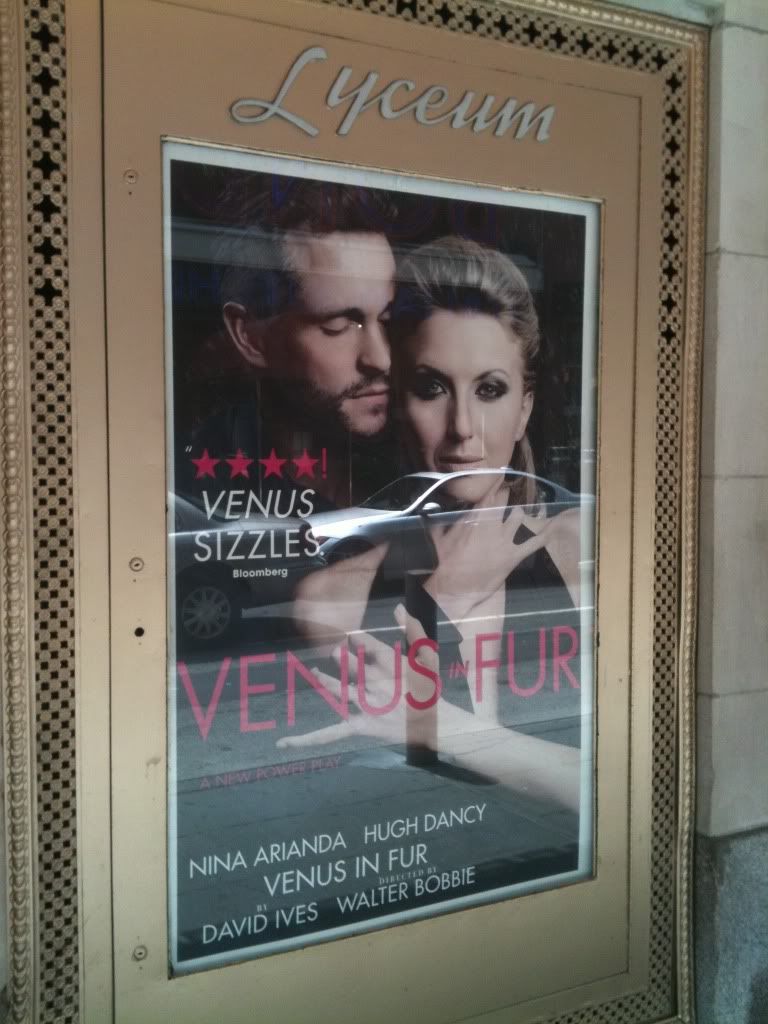
Arianda is a Goddess, and Other Musings on Venus in Fur


                So, I know that I’m hopelessly behind in all of this, so sorry to all 6 people who read this.  The end of the year stuff at school has been nuts, so I’ve barely had any time to write about the theater I saw in NYC over Memorial Day weekend.  But I couldn’t let it go any longer without discussing Venus in Fur!
                So, I’m a plan-ahead kind of gal, but I wanted to leave part of my whirlwind 2-day trip up to chance.  I left the Sunday matinee open, with plans to hit up TKTS and see what I could find there.  I got into the play express line, which was surprisingly long, and for the 45 minutes I was there (I got there before the booth opened), I debated what I was going to see.  I couldn’t decide between Venus in Fur and One Man, Two Guv’nors.  I actually asked one of the guys there handing out flyers, and he gave me good advice: see which one I could get a better seat for, and take that one.  He assured me that both shows were wonderful in their own way.  Well, the ticket-seller at TKTS was able to offer me a front-row seat to Venus in Fur, so I took it.
                The only problem?  It was 11 in the morning, and the show wasn’t until 3.  Luckily, I was in the center of the universe, so I took the subway to the Strand bookstore.  I browsed for quite some time, bought a new copy of How I Paid for College…, and wandered back to Union Square to take the subway back to Times Square.  I must have had an air of confidence about me, because that subway trip marked the first of several times that day that I would be asked directions for how to get somewhere on the subway.  One man asked me, “do you take this train often?”, and, not wanting to seem like a tourist, my response was, “not so often, no.”  How silly.
                The time to enter the theater finally rolled around, and I took my seat.  It turns out, I was sitting with some ladies I met earlier in the day in the TKTS line.  We had a lovely chat – one lady didn’t realize that some shows have performances on Sunday evening, and once she found this out, she began busily deciding which one she was going to see.  I guess my five-shows-in-two-days feat is an inspiring one.
                Venus in Fur is presented without an intermission (which was perfection), and the show is just marvelous.  It’s hilarious, deep, and true.  I still cannot get over how amazing Nina Arianda is.  The woman is a genius, plain and simple.  She brought the character of Vanda to life with so much depth and so much truth.  I was peeling with laughter, but also so intent on the arc of her character – how does she do it!?  No, really, I want to know.  I’m writing this after the Tony Awards, but up to the awards themselves, I kept telling people, “If there’s any justice in the world, Nina Arianda will win the Tony.”  I guess my faith in the world is restored.  Clearly I’m not the only one who recognized her genius.  The woman is a goddess.
                Nina’s not the only thing I loved about the show.  Clearly, Ives’ writing is phenomenal.  Hugh Dancy was a great partner for Nina.  I loved the stark set.  It had those little touches that made it real.  You know, like the faded spots on the bulletin board from when a paper is left there a long time, and coffee cups and packets of Equal next to the coffee pot.  My favorite was the sign that said “Your mother doesn’t work here, so please clean up after yourself.”  It’s those little touches that made it so real.
                Even though the show ends just as things are getting really juicy, I love what it does and where it goes in just over 90 minutes.  As the two characters are reading the script to the play-within-the-play, they go there.  Like, really there.  Like, there’s a dog collar involved.  They do things that I’m sure are not equity standard for an audition.  I love that they are so willing to let a piece of theater take them someplace so raw and emotional.  Clearly, they both have hang-ups to deal with – Vanda is either a stalker or clairvoyant, and Thomas is a kind of uptight guy who needs writing to be his release.  The interaction between the two is impeccable.
                I know I’m not giving you much time, but please go see Venus in Fur before it closes in a few days.  You won’t regret it, not one bit.

Friday, June 1, 2012

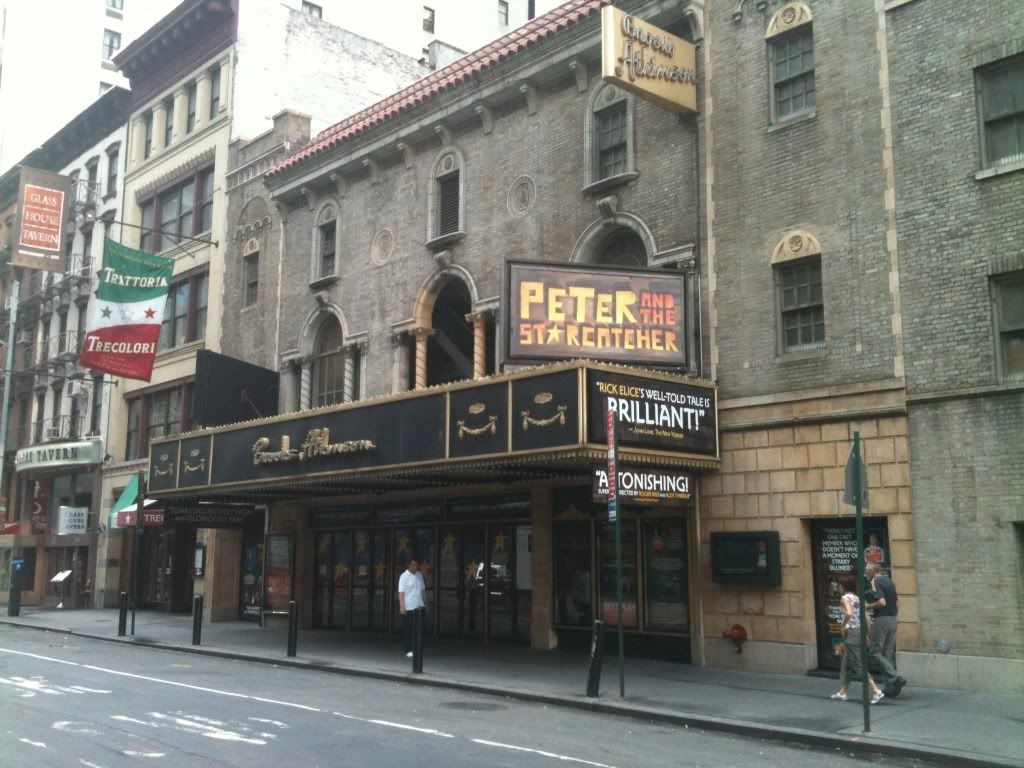
Unabashedly Gushing Over Peter and the Starcatcher


                I’m in love.  Truly, madly, deeply in love.  And I’m pretty sure the feeling is mutual.  The object of my affection?  Broadway’s Peter and the Starcatcher, of course!  I feel silly writing such a gushy post (hence the middle school journal overtones here), but I can’t think of anything bad to say about the show – it might actually be the best piece of theater I’ve ever seen.  Ever.
Photo from Broadway.com
                Actually, if I think really hard I could probably think of one negative thing to say.
                I got it.  My seat was in dead center in the front row of the mezzanine (there’s a gripe coming, I promise), and the seat was so close to the balcony edge that my feet were cramped.  But even that’s only because I’m 6 feet tall and I had already walked about 87 miles around Manhattan that day.  Normal-sized humans who take the subway to the theater won’t be able to find a single negative thing to say about Peter and the Starcatcher.
                I literally cannot remember the last time I felt so captivated by theater.  It’s like when kids who can’t sit still for ten seconds but when put in front of a computer can spend hours playing a video game.  I’m that ADD kid, and Peter is my video game.  Except it’s infinitely cooler than a video game.
                First of all, the acting is perfect.  Yes, I’m talking about Adam Chanler-Berat, Celia Keenan-Bolger, and Christian Borle, but I am also referring to the entire ensemble.  Every one of them is a genius.  Second, the design of the show is so lively, uplifting, and perfect in its simplicity.  At the very same time, it reminded me of when I would put on shows in my yard as a kid and made me wonder in awe at the way that simple things like ropes and ladders can truly become pirate ships and tropical islands.
                As you read this next part, please keep in mind that I have no personal stake in the merchandising department for the play.  Buy the annotated script.  Do it.  It includes wonderful insight into the show, yes, but my favorite part is the quippy and brilliant stage directions, like the perfectly penned “A Great Silence of Piratical Awfulness” (Act I. Scene 7. Line 7).  Genius, right?  Seriously, buy it.  But first you have to buy a ticket to the show, which is the best thing you’ll buy all year.

Tuesday, May 29, 2012

To Be or Not To Be Offended? - My Thoughts on Clybourne Park


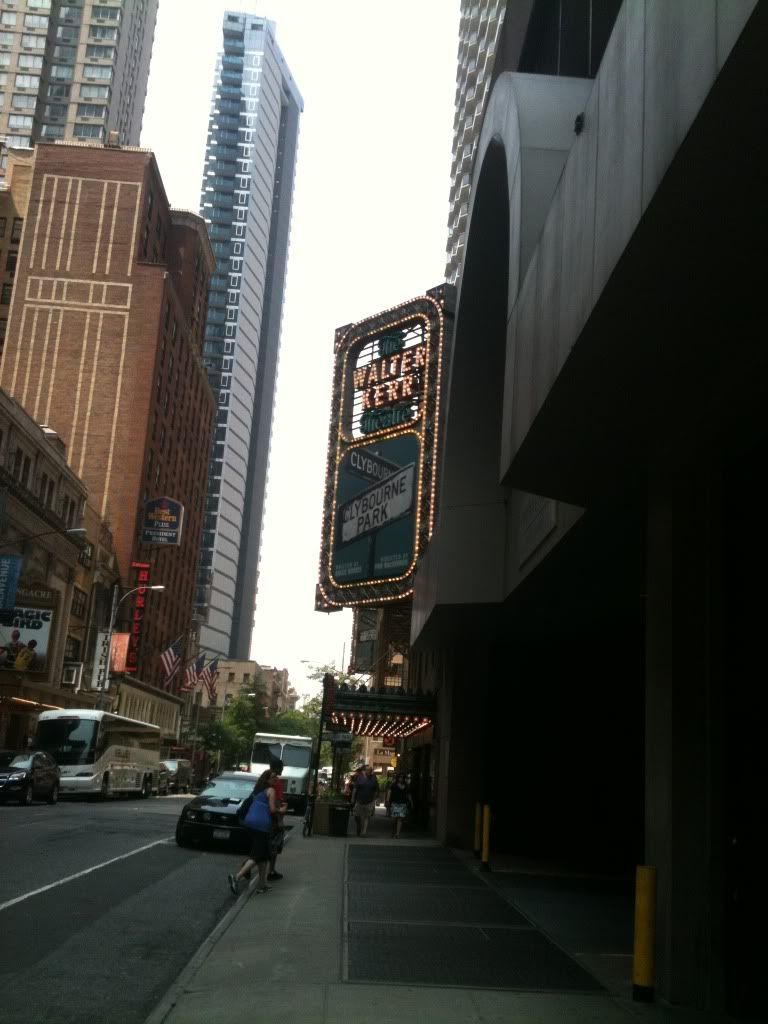
                I’m worried that I’m going to sound nit-picky, but I have something I really need to get off my chest after seeing Clybourne Park on Broadway on Saturday.  Let me start by lauding the play for its merits.
                The play makes some important points through its slightly overblown (on purpose!) characters who represent some things we don’t want to face about ourselves and society.  During my time spent as a sociology major (side note – actual job opportunities stemming from a degree in sociology: zero), I learned a lot about the sensitive issues surrounding changing neighborhoods, especially regarding gentrification.  I think the characters were fairly adept in expressing how reluctant we are, as a society, to face these issues.  I applaud the play and the playwright for presenting these issues without claiming to offer a solution.  There are merits and drawbacks to ethnically diverse neighborhoods, and we as a society (like the characters in the play) are more comfortable skirting around the issues than addressing them head-on.
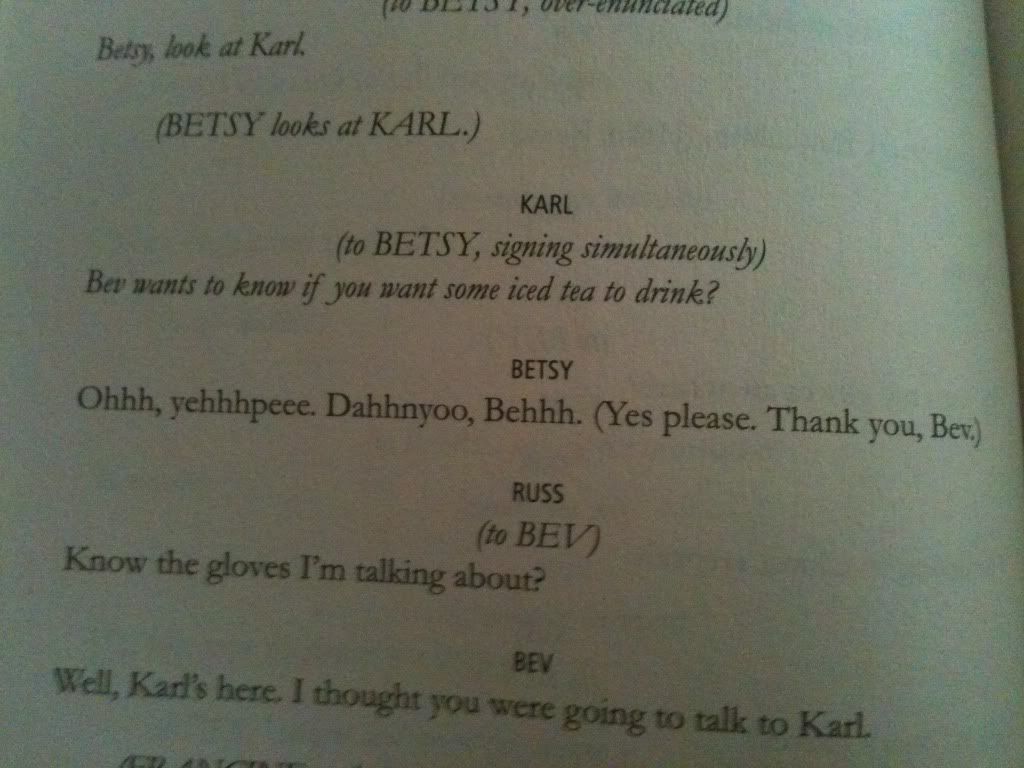
From the script of Clybourne Park
                But I have an issue.  Although it is in my nature to shy away from conflict, I feel confident that Bruce Norris (the playwright) would want me to just come right out and state my grievances.  It might kind of be in the spirit of the play, in the context of who-is-allowed-to-be-offended-on-behalf-of-whom that I find my gripe.  I have been known to be too concerned with political correctness and too easily offended on behalf of others, but I think I have a valid (if inflated) point to make.  I was disappointed by the character of Betsy.  She is a deaf woman (and I use a lower-case d on purpose in this instance) who is the only character in the show who is one-dimensional and there for the purpose of being the butt of jokes.  I don’t think the writing is an accurate or respectful representation of the Deaf (capital D on purpose) community.  I’m not Deaf (or deaf), I’m not part of the Deaf community, I don’t have Deaf friends or family members, and I don’t speak on behalf of those who are/do.  I simply speak on behalf of me and my feelings.  And yes, I do realize that a large part of her presence in the show is to point out the ignorance of many of the other characters (particularly Bev, who has no idea how to act around a deaf person).  But I really don’t like the way her lines are written in the script (see picture), and I don’t think it’s necessary to write her in such a way.  The punch lines at her expense felt cheap to me.  I teach ASL to hearing K-2 students.  Generally, I start off with kids who don’t even know what it means to be d/Deaf.  A vital part of my curriculum is explaining Deaf culture and helping students to understand that Deaf kids are just like them, with one (minor) difference.  Deaf people (that is, culturally Deaf people) often don’t regard their deafness as a handicap, just a part of who they are, something worthy of pride.  Deafness is truly a culture in the anthropological and sociological sense. 
A lot of these thoughts occurred to me while I was seeing Tribes at the Barrow Street Theater, which shows such a multi-dimensional Deaf community of real people, with merits and faults.  Betsy is essentially lacking in personality of her own – she is her deafness, and for the purposes of this play, her deafness is a handicap (people actually swear at her to prove the point that she can’t her them – we get it!), and that handicap is supposed to be funny.  I might be too uptight here, but I didn’t like that.  You know what?  If that means, I’m uptight, I’m okay with that – read on.
                When I get in a fit of being all riled up like this, it makes me want to write off the whole play because of this one instance.  But I can’t.  Because it gets so many things right.  Because it made me really examine how I feel about race.  And, because of how I feel about Betsy, it really challenged me to think about my position and how racial attitudes and attitudes toward other communities than mine differ.  Why am I so quick to rush to the defense of people who are fully capable of defending themselves?  It’s a lot like the characters in act two – not sure if people need or want people of other races to be progressive on their behalf.  Even now, I worry about whether or not I should even be worried about this.  Is that silly?
But, at the end of the day, this work and these characters, including Betsy – no, especially Betsy, challenged me.  And isn’t that what the theater is for?

Saturday, May 28, 2011

A history lesson like no other at The Normal Heart

                Once my parents and I decided that, for our first family vacation in years, we would go to NYC to see a bunch of Broadway shows (seven, to be exact), I knew we had to see The Normal Heart.  I had heard so much buzz about it, and my parents were willing to go along, as well – my dad because I told him he had to and that it was groundbreaking theater, and my mom because she loves Jim Parsons.

                So, on that Tuesday, two days after arriving in New York City for the best vacation ever, we settled into our seats at the John Golden Theatre – in the center of the front row of the rear mezzanine, to see The Normal Heart, my first ever straight play on Broadway.  Though the seats at the Golden were slightly cramped, I was busy reading my Playbill and taking in the sights of the theater.  The theater walls were mostly white with some gold and blue emblems for decoration.  The relatively less ornate décor of the John Golden was a good companion to the set design.  Before the show began, the stage was completely empty, and the backdrop was solid white, with quotes etched out.  Once the play began, the white backdrop was used for well-designed projection.  The set pieces, which came out with the actors, were minimal and utilitarian.  I liked it.  It let the acting shine.
                No matter how someone feels about this play, it is undeniable that the acting is first-rate.  My particular acting shout-out has to go to Ellen Barkin.  She was simply stunning.  Her second-act monologue brought me to tears, simply from how committed she was to her character and how committed her character was to the cause.  It doesn’t get better than that, folks!  The ensemble cast was stunning – every single actor contributed nicely to the piece as a whole.
                As for the play itself, I found it moving.  There was a point when I was thinking it might be too focused on the anger of Ned, but when I thought about the people who aren’t in the play – everyone else in New York City at the time – and I realized that Ned is one of only a handful of people who were that furious, it made sense.  The context is important.  In addition, at the TalkOut afterward, Cynthia O’Neal said that the play shows exactly what it was like in the early 1980s: young men were dying, and no one really seemed to care at all.
                It was just pure good luck that the tickets we had for The Normal Heart fell on the night of the TalkOut with Anthony Rapp and Cynthia O’Neal, founder of Friends in Deed.  We bought the tickets before the TalkOut was announced, but I was pretty excited that I got to go to it.  My mom is still disappointed that she was never called on, even though she was raising her hand, but other than that, my family enjoyed it as well.  The topics discussed ranged from what it was really like in New York City in the early 1980s, particularly for the LGBT community to what is being done now to make sure stories like this don’t get pushed aside.  Aside from the fact that it was really cool to be sitting mere feet from Anthony Rapp (I have some friends who are totally jealous), it was great to put the show, which takes place in the early 1980s, into context and really see what it means to a current audience.
                As someone who wasn’t born until 1986, what I took away from my experience at The Normal Heart was an understanding of what happened to the generation before me, from an uncensored source, depicted honestly and beautifully.

Wednesday, May 25, 2011

Venturing UpStage for The America Play at Triad Stage


I apologize that this is a very late post, which has become an unfortunate trend for me.  However, I was in NYC doing my theater addict thing for eight days (I saw seven Broadway shows, which I will, of course, be writing about), and didn’t get around to writing this until now.
Since seeing Educating Rita late last fall, I’ve been enamored with Triad Stage.  I love their main stage productions.  However, I became increasingly curious about their UpStage Cabaret, and decided to buy a ticket to see their newest UpStage Cabaret production, The America Play, having no idea what to expect of the space or the work.
                Immediately upon entering the space, I realized that it was the Triad Stage that I know and love, just… a little more intimate.  I’m not used to seeing theater from regular chairs, sitting at a table.  I am, however, used to Triad Stage’s amazing and innovative sets.  I felt right at home sitting mere feet from a large dirt mound with trees, two old televisions, political posters from throughout America’s racially-charged history, and a big hole.  No, it wasn’t an accident – it was the awesome, though small, set, in the middle of the room, surrounded by cute little tables and mismatched chairs.
                I’m not used to being that close to the actors.  I am, however, used to Triad Stage casting incredibly talented performers to populate their productions.  I was mesmerized by the actors.  While I wasn’t always entirely sure exactly what the characters were talking about (the play tended toward the abstract), I was never unsure of how the characters felt or who they were.
                As a fan of great theater, and a not-so-secret admirer of Triad Stage’s work, I must say that this show did not disappoint.  I was moved, I was challenged, I was entertained.
                The one thing I really missed was a talk-back.  My season pass tickets are for the main stage performances which include Triad Stage’s InSight talk-back series.  These talk-backs are a great way for me to unwind from a show, figure out what I just saw, and understand and appreciate the work and the playwright even more.  With The America Play, I was desperate to talk about it!  I was at the show by myself, so I didn’t have anyone to bounce crazy theories off of, or a scholar grounding me into the context of the play.  I very much enjoyed the show – it was an intense play, and I wanted to delve even deeper into the hole – both literally and metaphorically.
                I can’t wait to see what will be at the UpStage Cabaret next season!

Thursday, April 21, 2011

Heading Down South with Triad Stage's Steel Magnolias


                Now that I’ve seen a few plays at Triad Stage in Greensboro, there are a few things I’ve come to expect, and I’ve yet to be disappointed.  This past weekend, I saw Steel Magnolias at Triad.  I have to admit, I was a little iffy about this one before I saw it.  I personally disdain anything in the “tearjerker” genre – I cry at Hallmark commercials.  No one needs to see me weep in public.  I like dark stuff, but not sappy.  I’ll admit – I was worried.  I won’t make you suffer until the end to find out that I did enjoy the production.  I even challenged myself to not cry.  I will, however, make you wait until the end to find out if I rose to my own challenge.
                One of the things I’ve come to expect from Triad Stage is killer set design.  I love their sets.  Especially with the way they have their seating is arranged, the set design is key.  I loved how it immediately felt like a carport-turned-salon, the moment I walked in.  I really appreciated the tiniest details, like that the “grass” was brown where people would have been walking on it up to the door.  They really thought of all the tiny details that make a set seem real.
                Another thing I’ve come to expect is the use of real, working sets and props.  I’ve said it before, and I’ll say it again: it really does make a difference when water comes out of the sink, there’s actual coffee in the coffee pot, and real sugar in those packets.  It sounds trivial, but, trust me, it’s important.
                My season tickets are for the Sunday matinees which include the InSight talkbacks.  I’ve found this to be critically important to my theatergoing experience at triad.  I love the people they bring in to do the talkbacks, and my appreciation for each work grows exponentially from attending.  This time was, of course, no exception.  I enjoyed the production, but the talkback helped me understand it on another level.  I really miss my college English courses, just sitting around and talking about theory and different works, and these talkbacks are my “college fix.”  It is so beneficial for an audience to be able to reflect on what they’ve just seen, and to listen to the reflections of others – both from scholars and fellow audience members.
                I’m not a native southerner, and I’m not your typical twenty-five year old woman.  I have no plans for marriage, and having children (at least in the next ten years or so) is the exact opposite of what I want in my life.  Perhaps because of this, I had some trouble relating to Shelby, the character in the show closest to my age.  I found myself relating more to the other characters in the show, the salon ladies, maybe because they remind me of my mother.  Somewhere around intermission, I realized that there are many more ways to relate to a show than based on the age of the characters, and that it was okay for me to relate to Ouiser more than Shelby.  Once freed from this struggle, I was able to relax a little bit more, and realize that the show, while technically about Shelby, is really about these women who care about her.
                So, did I cry?  Only a little.  I was able to keep myself from outright weeping.  Thank goodness for that, otherwise the box office would be getting a lot of complaints about audience behavior – I’m a loud crier.  I did shed a few tears, however.  I was most touched by Ouiser and her reaction to tragedy.  Did I meet my own challenge?  You decide.

Friday, February 25, 2011

Pondering Life and Death at Triad Stage


                It’s no secret that I love Triad Stage.  They consistently put on high-quality theater, and my most recent visit to Greensboro proved no different.  I went this past weekend to see The Sunset Limited, a Cormac McCarthy play, and the talkback after.  It was great.  Also, having season tickets to Triad Stage is a great excuse for me to visit my best friend, who lives in Greensboro.
                I think it’s time you knew about the thing that really gets under my skin.  My secret pet peeve is when actors pretend to eat and drink while on stage.  I can’t stand it when I know that there’s not actually any coffee in their mugs or soup in their bowls.  It bothers me to no end.  I realize that I shouldn’t let it get to me, but I do.  I really do.  That being said, I have to hand it to Triad Stage for avoiding committing this faux pas.  The thing I perhaps loved the most about the show was that the kitchen on stage was a working kitchen, the characters actually made and drank real coffee, and cooked and ate real food.  Thank you!  I realize that this may seem small, but to me, it’s important.
                So, the show was interesting.  I don’t have a lot of insight this time into the subtext of the play – I think it pretty much speaks for itself.  I have a very firm opinion about what happens in the moments following the conclusion of the play, but I don’t want to ruin it for anyone.  If you really want to know what I think about the matter, send me an email.
I think the way the actors brought the characters to life was phenomenal.  There was so much text for them to memorize, and very little in the way of movement about the stage.  With a two-character play, the chemistry between the two characters/actors is essential.  These characters were believable without being dull.  Bravo.
I absolutely loved the talkback – it really helped me wrap my head around the play and the production.  I recommend that anyone buying tickets to a Triad Stage show get tickets for the performance with the talkback.  You won’t be sorry.

Wednesday, February 23, 2011

The Threshold of Revelation - Seeing Angels in America at Playmakers Rep


                When I saw that the PlayMakers Repertory Company was doing Angels in America, I knew without hesitation that I had to be there.  I saw their production of Fences, and absolutely loved it.  I had never seen Angels in America performed on stage, and I was chomping at the bit for an opportunity to do so.
                Several years ago, I saw the HBO movie, and my then-roommate and I still can’t get over the fact that Meryl Streep was the rabbi.  I didn’t remember too much from it, except I remembered the line “my religion doesn’t believe in Mormons,” because I thought it was pretty hilarious.  I also remembered Patrick Wilson, because ever since then, I’ve had a huge crush on him – but I think the rest of America has, too.
                Back in December, when I was planning my whirlwind trip to New York City, there was a brief moment in which my friend Cliff and I thought we would go see Angels in America Off-Broadway.   Of course, tickets were sold out, and the way their schedule was running, we wouldn’t have been able to see both parts in order anyway.  But, when I was at PlayMakers Rep, it was like the distance between New York and North Carolina dissolved, and the difference between regional and Off-Broadway disappeared.  It was apparent from the get-go that I was seeing high-quality theater.
                First of all, the set was spectacular.  Appearing minimalist at first, it became clearer as the course of the play went on that it was a carefully thought-out design which really provided a lot for the telling of the story.  I really like how the pieces of the set slowly come apart, showing at the same time this sort of paradox between destruction and revelation.  The scenes change rapidly in Angels in America, and I appreciated how smoothly the actors and the set transitioned between scenes.
                I think my absolute favorite thing about this production was the sound.  I’m not a technical theater expert or anything, but I thought the placement and content of the sound design was phenomenal in what it brought to the show.  The set was pretty minimal, so sound was what really defined place for me.  The city noises, the nightclub music, all of it was perfect.
                Of course, the acting was great.  It is shows like this that make me wish I were an actor – I’d give anything to be onstage in a production like this, bringing these amazing characters to life.  All of the characters were so believable, which is tricky in a show like this.  The characters could easily be portrayed as over-the-top or larger-than-life, but the actors in this production were so controlled and tuned in to who these characters really are.  I appreciated their attention to Kushner’s words, and it was obvious that a lot of thought and work went into bringing those words to the stage.  I also appreciate the amount of time it must have taken to memorize all those lines!
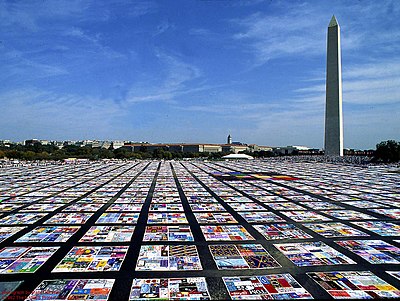
                 I also loved the inclusion of the AIDS quilt in the lobby.  I grew up in DC, so my parents took me to see the AIDS quilt on the national Mall when it was there in 1996.  I was only ten, but I knew I was seeing something important.  The AIDS quilt is such a fascinating piece of American history, and I’m glad that a part of it was able to be in the lobby of the theater.
                So, all in all, this production of Angels in America is must-see theater.  I logged a total of 120 miles traveling to and from the show (30 miles each way, two round trips), and each mile was completely worth it.  It was all the little things that made the show remarkable.  Of course, the acting was great, something I expect of PlayMakers Rep, and the writing was great, but I knew that already.  It was the details that made it stellar – the subtle scenery, the sound cues, the scene transitions, the lighting, the AIDS quilt in the lobby… the list goes on.